

Fuse Launches Marine & Logistics Hub, Bringing Live Signal Synthesis to a Market Where Price and Severity Are Moving in Opposite Directions
NEW YORK — September 1, 2026 — Fuse International, Inc., the AI-native commercial insurance intelligence platform, today launched its Marine & Logistics Hub, extending Fuse’s continuous signal synthesis to one of the most structurally mispriced segments in commercial property and casualty. The hub is live now at fuserisk.com and brings the number of industry hubs on the platform to eleven.
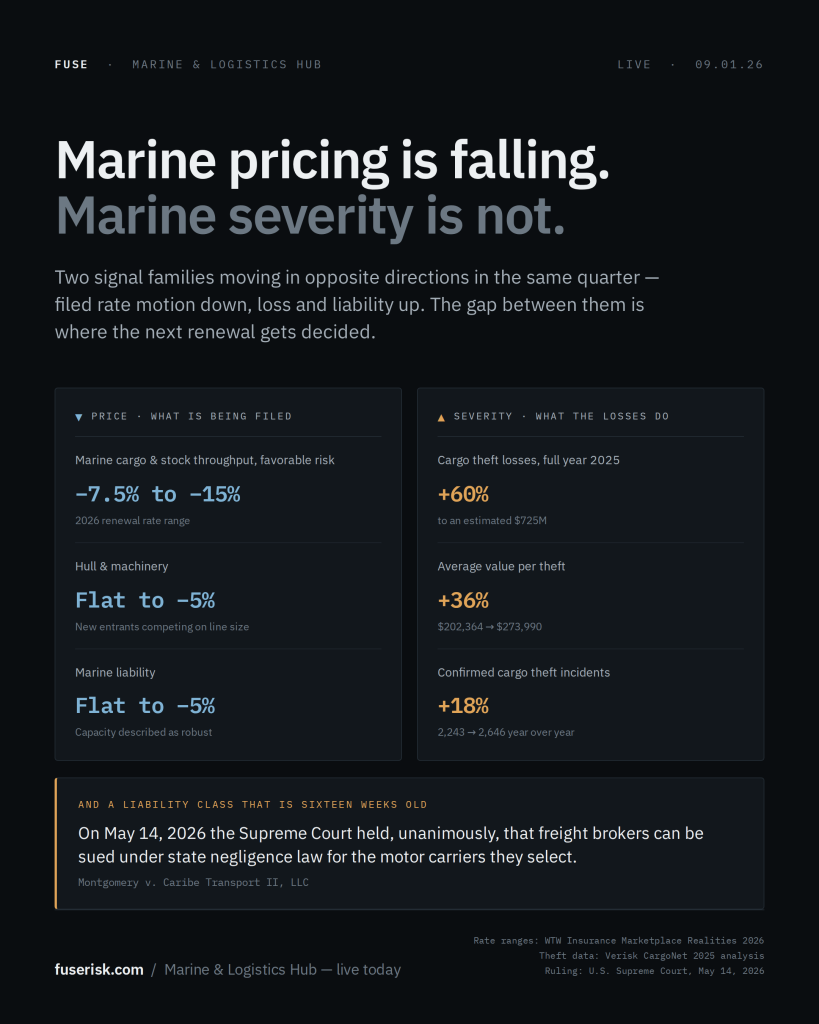
The launch lands on a market moving in two directions at once. Broker marketplace guidance for 2026 places marine cargo and stock throughput renewals for favorable risks at reductions of 7.5% to 15%, with hull and machinery, marine liability and U.S. protection and indemnity all in a flat-to-minus-5% band, as new entrants compete for share and deploy larger line sizes than at any point in the last five years.
The loss picture is not moving with it. Verisk CargoNet’s analysis of 2025 recorded 2,646 confirmed cargo theft incidents, an 18% increase year over year, with estimated losses of nearly $725 million — a 60% rise — and an average value per theft of $273,990, up 36% from $202,364. The shift reflects organized crews targeting high-value shipments selectively rather than opportunistically.
A third signal changed the liability floor underneath the segment. On May 14, 2026, the U.S. Supreme Court held unanimously in Montgomery v. Caribe Transport II, LLC that state negligent-selection claims against freight brokers are not preempted by the Federal Aviation Administration Authorization Act, reasoning that a broker’s choice of motor carrier concerns motor vehicle safety and therefore falls within the statute’s safety savings clause. The decision opened a nationwide negligence exposure for brokers and 3PLs that most contingent programs were neither underwritten nor priced to carry.
“Any one of those three is a headline. Read together they describe a specific condition: price is being competed down on classes where per-event severity is climbing and a new liability theory just cleared the Court. That gap closes on the renewal or it closes on the claim. The whole point of the hub is that a broker sees it while it is still a filing.”
— Sean Bourgeois, Founder and CEO, Fuse
What this Fuse hub covers
The Marine & Logistics Hub spans the full marine and logistics stack:
- Ocean marine — hull and machinery, cargo, stock throughput, protection and indemnity, marine general and excess liability
- Inland marine — motor truck cargo, contractors equipment, builders risk, transit, bailee and warehouse legal liability
- Logistics operations — freight broker contingent cargo and contingent auto, freight broker and 3PL professional liability, drayage and intermodal, ports, terminals and stevedores, warehousing and distribution
- Statutory and specialty — Jones Act maritime employers liability, USL&H longshore, charterers legal liability
How it works
Fuse runs dozens of specialized agents continuously across declared, cadenced public sources, cross-checking every signal against the states and lines a user selects and against every other signal. Inputs monitored for this vertical include state rate and form filings across ocean marine, inland marine and commercial auto; FMCSA broker and motor carrier registries, including authority grants, revocations and bond status; port and waterway throughput and dwell; named-storm tracks and marine advisories mapped to terminals, yards and warehouse locations; negligent-selection and cargo liability docket flow; carrier appetite and program filings; statutory results by line; and freight rate, diesel and trade volume indicators.
The output is not a feed. It is a single continuously updated, ranked read on marine and logistics conditions, delivered into the same six-rail workspace as the platform’s other hubs — Market, Action, Capacity, Place, Network and Forward — and adapted to the user’s seat, whether retail producer, account manager, underwriter or executive.
Every figure in the product links to the filing, registry entry, docket or government dataset that produced it. Where a source is licensed and not yet cleared for display, the panel is labeled rather than populated. Fuse does not surface a number it cannot attribute.
Timing and context
U.S. container import volume is on pace for roughly 25.5 million TEU in 2026, essentially flat against 2025, but the year’s volume arrived on a materially different schedule, with retailers pulling merchandise forward ahead of late-July tariff changes and May emerging as the peak month. Flat annual volume distributed differently across the calendar changes where inventory sits, for how long, and against which sublimits — an exposure shift invisible in an annual total and visible in the weekly read.
Availability
The Marine & Logistics Hub is available today at fuserisk.com/industries/marine-logistics. Fuse is free to start with no credit card required. Pro accounts are $999 per month per seat and unlock statutory, cedent and capacity intelligence drawn from Schedule F and EDGAR reinsurance data. Enterprise terms are available for broker, carrier, MGA and reinsurance deployments.
About Fuse
Fuse International, Inc. is an AI-native commercial insurance intelligence platform serving brokers, carriers and reinsurers across the full risk value chain. Fuse synthesizes rate filings, statutory financials, litigation trends, cost data, peril activity and capital and reinsurance signals into market intelligence by vertical and state, delivered through a product suite spanning Radar, Mark, Beacon, Watch, Pulse, Prism, Lens and Tape. Fuse operates eleven industry hubs plus dedicated E&S and reinsurance surfaces, with continuous coverage across all fifty states. The company is headquartered at 261 Madison Avenue, New York, NY 10016. Learn more at fuserisk.com.
Media Contact
Fuse International, Inc.
261 Madison Avenue, New York, NY 10016
fuserisk.com