

What Carriers Can Learn from Other Carriers About Using AI Most Effectively
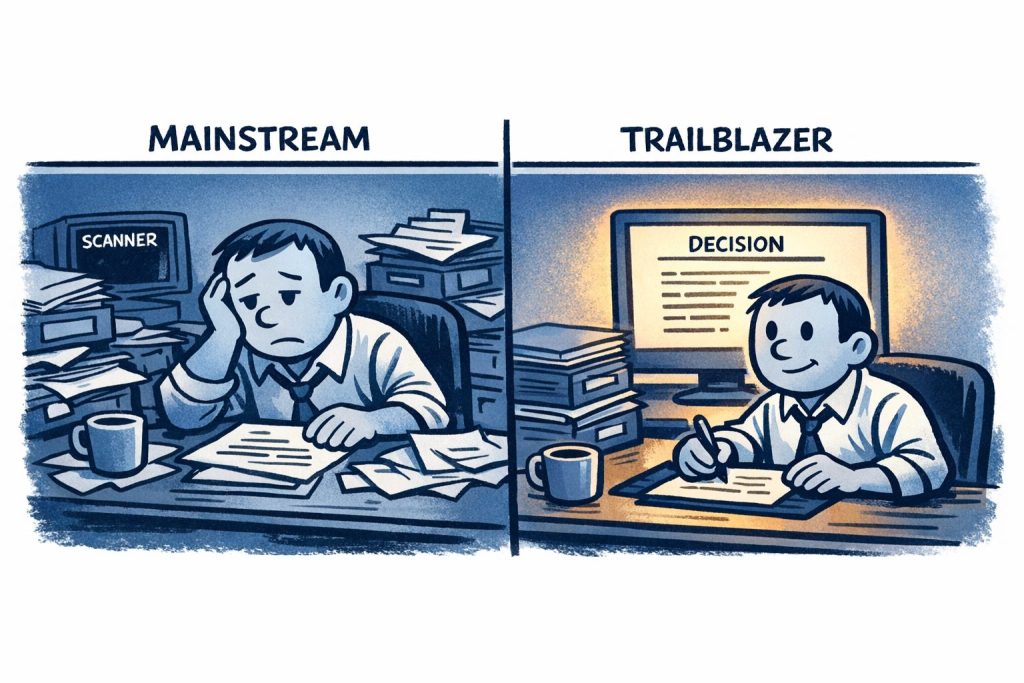
Capgemini just published its 19th World Property and Casualty Insurance Report, and the headline number is doing real work for the AI-skeptic camp. Ten percent of P&C insurers, which Capgemini calls “intelligence trailblazers,” posted 21% higher revenue growth and 51% greater share price gains over the last three years compared with the rest of the industry. The reason is not that they bought better models. It is that they stopped automating the easy parts.
‘Trailblazer’ carriers spent on a different line item
Across the 344 senior P&C executives Capgemini interviewed, 72% of AI investment goes to technology and infrastructure, while only 28% goes to change management. Forty-two percent of insurers do not track any AI metrics at all. Sixty percent remain stuck in pilot or proof-of-concept. Only 35% of the top 20 global P&C insurers, ranked by gross written premium, explicitly link AI strategy to business outcomes beyond efficiency.
The trailblazer cohort inverts those ratios. Forty-three percent of their AI investment is directed at change management and beyond-basic training, against 11% in the mainstream. Sixty-nine percent track AI experimentation systematically, against 24% in the rest of the field. Forty-seven percent of employees with access to AI tools across the broader industry report their workday remains unchanged after 18 months. The trailblazers are not running a different technology stack. They are running a different organization on top of it.
Where AI stops at the edges
The most pointed sentence in the report, for anyone who has spent time near a claims floor, is on page 30. AI, Capgemini’s analysts write, “has been deployed only at the edges of the claims process, around document processing, image analysis, and fraud detection, without touching the decisions that drive loss ratios.”
That is a precise diagnosis. Of the 200 claims adjusters Capgemini surveyed for its Voice of Employee work, 64% are struggling to meet turnaround targets due to volume, 48% are struggling to maintain customer satisfaction, and 46% are under pressure to reduce adjustment expense.
The same adjusters report that AI mostly helps them with intake, indexing, and image triage. The actual decision work, coverage determination, liability assessment, settlement positioning, still rests on individual judgment applied inconsistently across teams, regions, and complexity levels.
The same pattern shows up in underwriting. Fifty-seven percent of underwriters spend most of their time on routine tasks. The carriers that have deployed underwriting workbenches see a 1.4x lift in book growth, but the workbench compresses gathering and review. It does not change the decision flow.
Claims correspondence is the missing piece, and it is measurable
In my work building ai claims automation at Voltaire, the pattern Capgemini describes is not abstract. It is the exact pattern carriers walk us through when we audit a claims operation. The FNOL pipeline has been worked over. Document classification has been worked over. OCR is deployed. Some carriers have agentic intake in production. A US-based homeowners carrier referenced in the Capgemini case studies achieved 99.9% straight-through processing on FNOL with a Roots AI deployment, with cycle time down 73% over six months.
That is meaningful work. It is also, in Capgemini’s framing, edge work. The decision artifact that actually defines the claim, the written communication to the policyholder, has not changed.
The Reservation of Rights letter, the coverage acceptance, the partial denial, the ongoing status update, the closing letter: these are not template-filling exercises. They are the externalization of the coverage decision, the regulatory disclosure obligations of the jurisdiction, and the carrier’s good-faith posture toward the insured.
We catalogued the discipline in the Claims Correspondence Compendium because the field has accumulated more institutional knowledge than the tooling around it reflects. These letters are also the artifact that plaintiff counsel deposes against. When Capgemini writes that “the core claims decision-making process remains mostly unchanged,” what they are describing, for the claims function, includes the correspondence layer. Adjusters are writing the same letters they wrote in 2018, with the same template drift, in tools that do not see the policy or the claim file.
That is the core-process gap in concrete form. And it is large enough to matter to a loss ratio.
AI that works sits next to the adjuster, not on top of them
Capgemini’s “expert-centric P&C insurer” framework lays out four building blocks: leadership that defines human-AI collaboration boundaries, human experts who own exception handling and accreditation frameworks, a synthetic execution layer that handles routine work and escalates on threshold breach, and an orchestration manager that translates strategy into AI principles and governs AI proliferation across the enterprise.
For claims correspondence specifically, that framework reframes the question. It is not “can a model write a denial letter.” It is: where does adjuster judgment create irreplaceable value, in legal posture, factual nuance, and policyholder relationship management, and where can synthetic execution be trusted to act, with what governance, what audit trail, what escalation rules, and against what accreditation framework?
That framing is the design brief we operate against at Voltaire. The system sits in the middle of the claims workflow, at adjudication time, where the adjuster has already made the coverage decision and now has to externalize it correctly. The synthetic execution layer drafts against the actual policy, the claim file, and the jurisdictional requirements. The adjuster reviews, edits, and signs. The decision stays with the human. The tedium, the policy-language lookups, the state-by-state disclosure check, the template management, the bad-faith exposure audit, gets absorbed by the layer below them.
The adjusters embrace it for the reason employees usually embrace good tools: it removes the work they hate without removing the work they are paid for. They get hours back per claim, the letters get more consistent, and the carrier gets an audit trail that satisfies a regulator. That is what AI that is actually working in claims looks like, and it is the opposite of the pattern Capgemini found across the industry, where 47% of employees with AI access report no change to their workday after a year and a half. That’s not the case for Voltaire, where high adoption has made significant day-to-day impact and improves job satisfaction. Tools that show up next to the expert at the moment of decision get used. Tools that show up at the edges of the workflow get ignored.
The carriers that do not answer the irreplaceable-value question end up with the opposite outcome: shadow AI in the desk, adjusters using consumer chatbots to draft regulated communications, and a bad-faith exposure that scales with the carrier.
The governance overlay matters because the regulators have already published their expectations. The NAIC Model Bulletin on the Use of Artificial Intelligence Systems by Insurers, adopted in late 2023 and now in force in roughly half the states, is explicit that carriers must maintain a written AI program covering the design, validation, deployment, and ongoing monitoring of AI systems that affect consumer outcomes. A model that drafts a coverage position is squarely in scope. A trailblazer-style architecture, with explainability, escalation, and human accreditation, is also the architecture that satisfies the bulletin. They are the same problem stated twice.
What carriers should do before the gap compounds
Two things are measurable now that were not measurable a year ago. The first is the trailblazer gap itself. Capgemini is showing 21% revenue growth and 51% share price differentials in the cohort that redesigned work. That gap is going to widen, not converge, because operating-model advantages compound and AI capability advantages compound on top of them.
The second is the cost of inaction inside claims. The 64% of adjusters missing turnaround, the 48% missing satisfaction, and the 46% missing expense targets are the loss-ratio shape of running an architecture mismatch. The longer that mismatch persists, the harder it gets to unwind, because, as Capgemini argues, organizations harden around the workflows they ship.
For carriers under pressure to show AI results in 2026, the realistic move is not another pilot. It is to pick one decision-bearing process, claims correspondence is a defensible candidate because it touches every claim and every regulator, and redesign it end-to-end against the expert-centric model.
The trailblazer cohort is not pulling ahead because they have better tooling. The AI that is going to define the next phase of P&C is the kind that sits next to the adjuster at adjudication time, takes the tedium, leaves the judgment, and earns the enthusiasm of the people who actually use it. Two years from now, the carriers that did not make that distinction are going to be looking at the same 21% gap, only larger, and explaining to a board that they ran a lot of pilots.
See Voltaire in action — schedule a demo.