

We Kind of Wrote the Book on P&C Claims Correspondence
In 2022, a Utah court ordered an insurer to reimburse a $500,000 settlement it had never contested. The insurer had defended its policyholder, a doctor, for eight straight years. It paid the lawyers. It tracked the litigation.
It just never sent a reservation of rights (ROR) letter. The court held that after that long a silence, the carrier had waived every coverage defense it might have raised. One missing letter. Half a million dollars.
UMIA v. Saltz is not an outlier. It is one bead on a very long string.
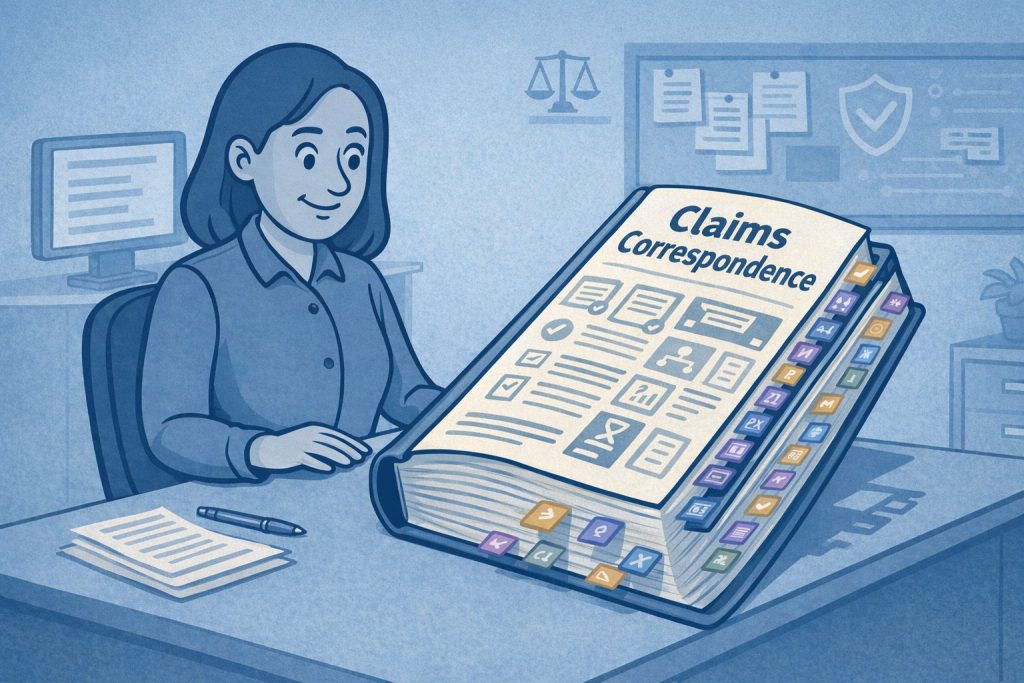
We just finished writing that string down. It is called The Secret History of Claims Correspondence, and we are publishing it free at voltaire.claims. We built it because we live in this data every day. Voltaire drafts claim letters. To draft one that complies, you have to know what ninety years of courts and legislatures decided each letter must contain. By state. By line of business. By claim type.
The arc: silence, obligation, infrastructure, code
In 1950, a carrier could receive a first-notice-of-loss and respond with nothing. No acknowledgment. No timeline. No written denial.
By 2025, a national carrier writing across all fifty states and five lines of business has to answer to thousands of discrete correspondence rules. Deadlines measured in business days in one state and calendar days in the next. Content mandated word for word in some jurisdictions and left to “reasonable detail” in others. Certified mail here. First-class there. Electronic delivery only with a signed consent form somewhere else.
We traced every one of these requirements back to the gap that produced it. The pattern repeats. A claim goes wrong. A court or a regulator defines what the next letter must say. A new obligation lands on the adjuster’s desk. The book walks through 670 court cases across all fifty states, spanning ninety years from 1933 to 2023.
Same letter, opposite result
The finding that surprised us most is how often one document produces opposite legal consequences depending on which state line it crosses.
Take the ROR letter. In California, San Diego Navy Federal Credit Union v. Cumis (1984) held that an ROR creates a conflict of interest. That conflict is serious enough to trigger the insured’s right to independent defense counsel at the insurer’s expense. The same letter, sent across the line into South Dakota, does the opposite. In St. Paul Fire & Marine v. Engelmann (2002), that state’s supreme court held that an ROR prevents a conflict. The letter transparently discloses the coverage question up front and removes the ambiguity.
One template, used by one national carrier, pays for a second law firm in one jurisdiction and avoids one in another. Your template library has to know the difference. So does the person approving the letter.
The closing letter nobody thinks about
Closing letters get the least attention of any correspondence type, and they carry some of the sharpest risk.
In Billy Baker Painting v. Barry (Kentucky, 2005), a workers’ compensation closure document was filed electronically but omitted the exact date benefits were terminated. One missing field. The Kentucky Supreme Court held that the defect tolled the statute of limitations indefinitely. The claimant could reopen the claim at any time, with no expiration. In Lewis Door Services v. Reker (2021), a claimant waited nearly three years and still won under the same rule.
A closing letter that looks finished is not finished until every mandated field is present. Miss one, and the file you thought you closed is still open.
What the book does not resolve
The epilogue walks up to a question the statutes never answered. What happens when the entity writing the letter is no longer a person.
Most of the correspondence rules in the book were drafted on an unstated assumption. A human being would make the coverage call, and a human being would put it on paper. Courts held that individual accountable. Regulators mandated what the individual had to disclose.
By the early 2000s, most large carriers had moved to rules-based document assembly. By 2025, generative artificial intelligence (AI) had moved from pilot programs to production. The framework built for human judgment now governs a process where neither the underlying decision nor the drafting may involve a person at any point. We do not resolve that tension in the book. We document how we got to it.
Why we wrote it
To produce a compliant ROR for a Cumis state, you need the case law. Same for a denial letter that mandates fraud-warning text in a specific typeface. Same for a status update that says more than “still investigating” — which some regulators treat as no update at all.
You have to carry every one of these rules in a structured form a computer can act on. We already had the data. The book is what happens when you ask the data to tell its own story.
Read it
The Secret History of Claims Correspondence is free. It has timelines, sortable fifty-state tables, and links to every source case. If you run a claims operation, your template committee will recognize every chapter. If you draft letters, you will find the case that your current form paragraph came from.
Read it at voltaire.claims. If you would rather see the data in action, we can show you how Voltaire drafts a claim letter in about thirty seconds, heavily automating a pretty manual process.