
Cincinnati Financial expands AI push amid competitive market
Cincinnati Financial Corporation capped a resilient 2025 with a strong fourth-quarter earnings beat, reporting net income of $676 million for the quarter — up 67% year-over-year — as the insurer navigated catastrophe headwinds and began leaning more heavily on artificial intelligence to sharpen its competitive edge.
The Ohio-based insurer posted full-year net income of $2.4 billion, a 4% increase over 2024, despite absorbing what management described as the largest catastrophe loss in company history at the start of the year. Non-GAAP operating income rose 5% for the full year.
Underwriting Discipline Drives Results
The company’s property casualty combined ratio came in at 85.2% for the fourth quarter, pulling the full-year figure to 94.9% — near the midpoint of its long-term target range. All operating segments posted combined ratios below 90% for the quarter, a performance CEO Stephen Spray called a direct reflection of the company’s long-standing underwriting discipline and its deep relationships with independent agents.
Net written premiums grew across most segments for the full year, with personal lines up 14%, excess and surplus lines up 11%, and commercial lines up 7%. The reinsurance units also contributed, with Cincinnati Global posting a combined ratio of 79.2% and 10% premium growth.
The AI Bet
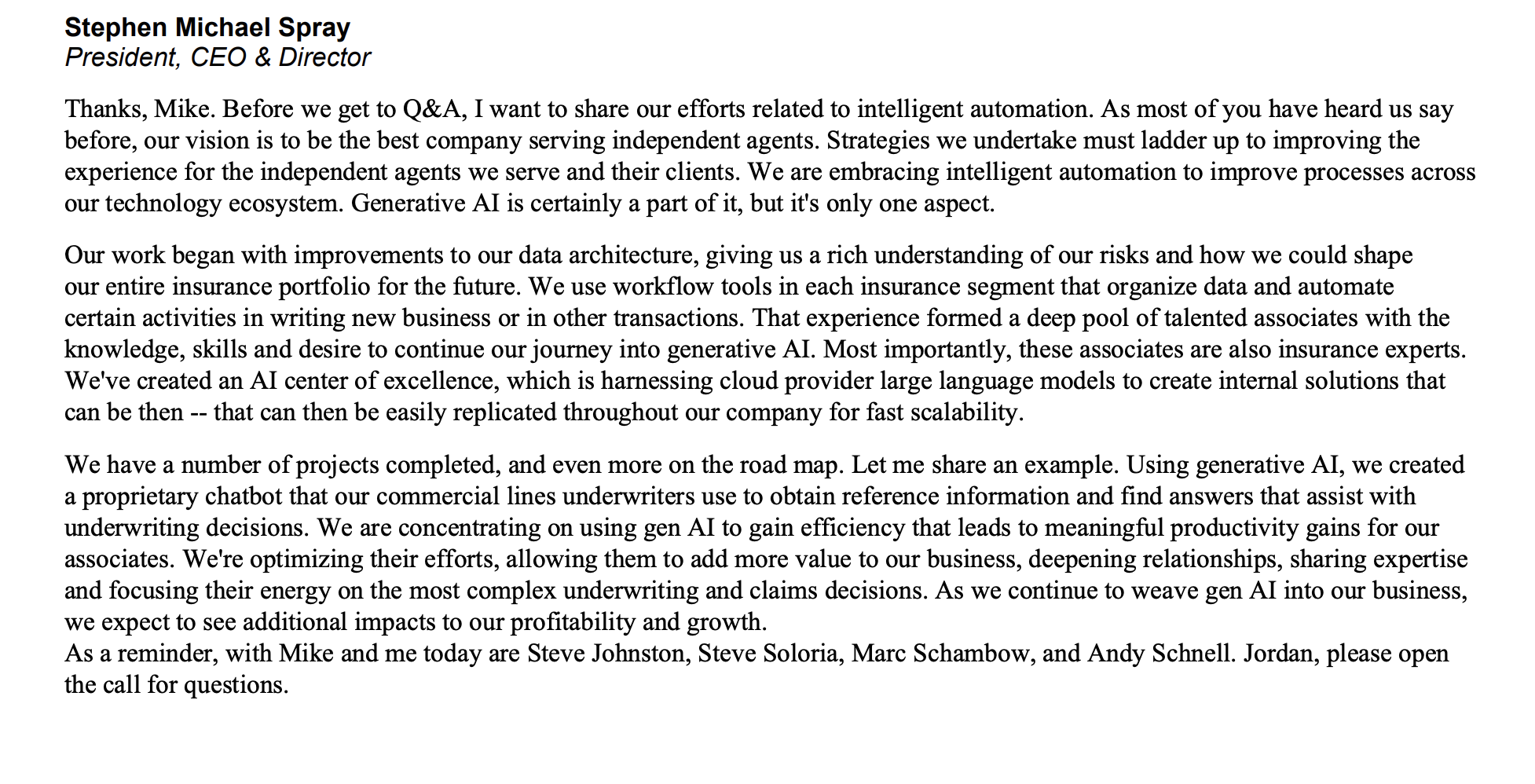 The company has established an AI center of excellence and built a proprietary generative AI chatbot for its commercial lines underwriters, allowing them to surface reference information and support underwriting decisions faster. Spray was careful to frame AI as one piece of a broader intelligent automation strategy rooted in years of data architecture work and workflow tooling.
“We are concentrating on using gen AI to gain efficiency that leads to meaningful productivity gains,” Spray said, adding that the goal is to free underwriters and claims professionals to focus on the most complex decisions rather than routine tasks. He expects AI integration to have a measurable impact on both profitability and growth going forward.
Navigating a Softening Market
Analysts pressed management on pricing trends, particularly in commercial casualty, where legal system abuse continues to create loss cost headwinds across the industry. Spray acknowledged that the commercial market became more competitive quickly in the fourth quarter — driven largely by property — but expressed confidence that pricing remains adequate across most lines entering 2026, with the exception of workers’ compensation.
On the personal lines side, management said it is well into a deliberate derisking process, particularly in California following wildfire-driven losses. The company has implemented new business moratoriums in certain areas and is working with state regulators, while recalibrating its view of catastrophe aggregation risk more broadly.
Capital and Investment Position
CFO Michael Sewell highlighted strong investment performance, with investment income rising 14% for the full year. Operating cash flow hit $3.1 billion, up 17%. The company returned $730 million to shareholders through dividends and buybacks, and ended the year with book value at a record $102.35 per share.
For 2026, the company expanded its catastrophe reinsurance coverage to $2 billion — up from $1.8 billion — while securing a roughly 7% rate decrease on its per-risk treaties, a sign of its strong balance sheet standing in the reinsurance market.
With net written premiums having doubled since 2018 to over $10 billion, Cincinnati Financial enters 2026 as a scaled, disciplined carrier betting that AI-driven efficiency and agent relationships will sustain its edge through an increasingly competitive cycle.