

The Adjuster Shortage Is Turning Claims AI Into an Operating Necessity
The Adjuster Shortage Is Turning Claims AI Into an Operating Necessity
There is a version of the AI conversation in insurance that still treats the technology as optional. A pilot here. A productivity experiment there. Something to monitor until the business case becomes obvious.
That version is aging quickly. The more immediate pressure is not that insurers suddenly became more excited about AI. It is that the talent model underneath claims, underwriting, service, and operations is under strain. A June 16 Economic Times report framed the issue plainly: insurers are adopting AI because trained insurance talent is scarce, and the pressure is showing up in claims processing, underwriting, onboarding, customer servicing, and fraud detection. Sedgwick predicts that 25% of claims adjusters will retire by the end of 2027.
The bottleneck is not only headcount. It is trained judgment, institutional memory, technical language, and the ability to move a claim file forward without creating a second problem in the correspondence.
That is why claims AI is moving from “interesting” to operationally necessary.
The Constraint Is Trained Judgment
Claims organizations have always been talent-constrained in ways that do not show up cleanly in a staffing spreadsheet.
An experienced adjuster is not just a person who can move work from one queue to another. They know when a file is missing the one document that matters. They know when a denial is technically possible but operationally unwise. They know that the phrase in a status letter that sounds harmless today may look very different when a regulator or plaintiff attorney reads it eighteen months later.
You cannot replace that knowledge with a general-purpose model and a blank text box. You also cannot scale it by asking experienced adjusters to spend more of their day copying policy language, hunting for templates, formatting status updates, or rewriting letters that should have been right the first time.
This is the real capacity problem. The industry does not only need more people. It needs to stop spending scarce claims judgment on work that is repetitive, language-heavy, and still risky when done by hand.
The Wrong Reaction Is To Automate Judgment Away
Talent shortage is a dangerous reason to buy software if it leads to the wrong design principle.
The tempting story is that AI can take work away from adjusters by making more decisions. In narrow, low-severity situations, that may be part of the operating model. The Economic Times piece cites industry estimates that simple, low-value claims may see straight-through processing rates of 60-80% globally over time. But that is not the center of gravity for most serious P&C claim work.
The expensive files are the ambiguous ones. The claim has incomplete facts. The policy language is conditional. The insured is frustrated. A vendor estimate conflicts with a field inspection. Counsel is involved. A state-specific timing rule is running in the background. In those files, the answer is not to remove the adjuster. It is to make the adjuster harder to overload.
That distinction matters. AI that replaces judgment becomes a governance problem, a litigation exhibit, and often an adoption problem inside the claims department. AI that clears the drafting, lookup, review, and consistency burden gives the adjuster more room to exercise judgment. That is also the shape of AI that adjusters actually adopt, because it respects the person who still owns the file.
I think this is the line the industry has to hold.
The Training Burden Is Hiding In Correspondence
Every claims leader understands the onboarding problem. The new adjuster does not only need to learn the system of record. They need to learn the carrier’s position on coverage, the difference between a complete and incomplete investigation, the right tone for a claimant, the right time to escalate, and the right way to explain a decision in writing.
That last part is easy to underestimate.
A claim letter is not just an output. It is a record of what the company knew, what the adjuster believed, what policy language mattered, what remained open, and what the insured or claimant was told. When a claims organization is thinly staffed, correspondence becomes one of the first places the strain appears. Templates drift. Status letters get thin. Denials become more generic. Review queues back up. Supervisors spend their time fixing avoidable drafting issues instead of coaching judgment.
This is where AI can be genuinely useful. Not as a substitute for the licensed professional. As a way to make the working environment more forgiving.
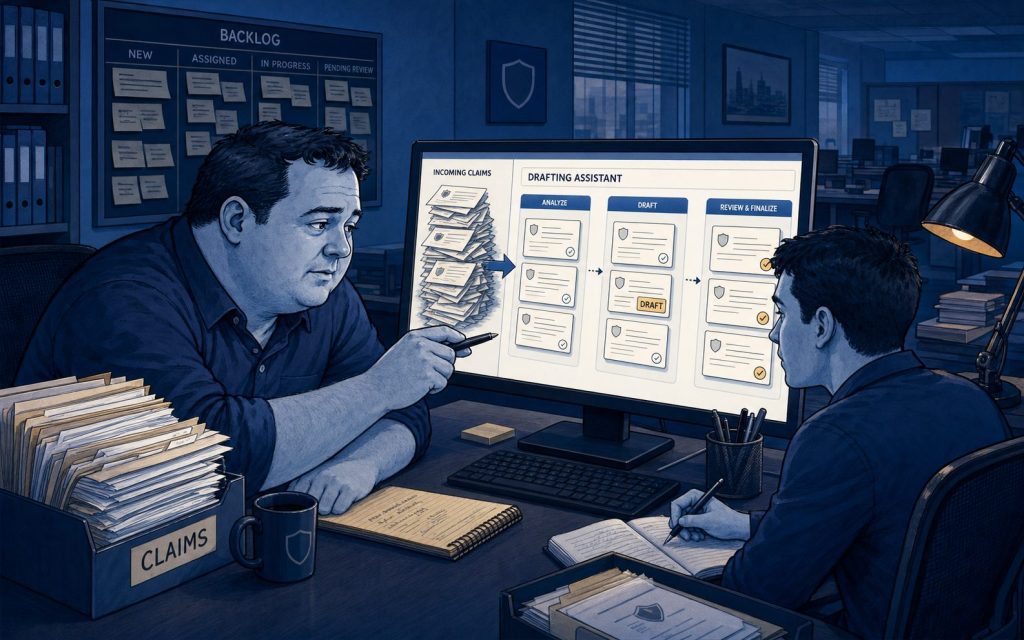
A good claims AI workflow should help the adjuster assemble the letter, pull forward the relevant facts and policy language, preserve the carrier’s preferred structure, and leave the decision where it belongs. That is the practical work behind AI claims letters: make the easy parts faster, make the risky parts more visible, and keep the adjudication with the claims professional.
At Voltaire, we publish the public Claims Correspondence Compendium because this complexity is not theoretical. State-by-state correspondence expectations, line-of-business differences, and letter-specific requirements are exactly the kind of operational detail that can overwhelm a thin team. The lesson is not that a tool should magically “know the rules.” The lesson is that claims organizations need workflows that give adjusters the time and structure to apply the rules correctly.
Capacity Expansion Is The Better ROI Story
The most useful AI business case in claims is not “we reduced headcount.” It is “we expanded the reach of the expertise we already had.”
That can be measured. How long does it take to draft a reservation of rights, denial, status update, or coverage position letter? How often does a supervisor send it back for rework? How many letters are delayed because the adjuster is hunting for the right form or language? How many senior adjuster hours are being spent on low-judgment cleanup instead of high-severity files? How quickly can a new adjuster get to competent production without relying on constant shoulder-taps? Those are not abstract technology outcomes. They are the operational benefits claims leaders, QA teams, training teams, and senior leadership can actually inspect.
The Economic Times report cites Deloitte India estimates that generative AI interventions can produce 10-35% productivity gains across claims, underwriting, customer service, and policy administration, with larger enterprise-level gains possible when the work is redesigned around the tools. Whether those exact numbers hold in every market is less important than the direction of travel. The value is in work redesign, not model novelty.
Claims leaders should be careful here. If the only metric is speed, the organization will optimize for shallow drafts. If the only metric is automation rate, the organization will push too much work past the adjuster. The better scorecard combines capacity, quality, and control:
- Draft time by letter type.
- Reviewer touch time and rework rate.
- First substantive communication cycle time.
- QA findings tied to missing facts, missing policy support, or vague explanations.
- Adjuster ramp time for new hires.
- Escalations prevented before a letter leaves the file.
That is not a flashy AI dashboard. It is a claims operating dashboard. That is the point.
The Human-In-The-Loop Requirement Is Not A Speed Bump
The NAIC’s adopted AI model bulletin keeps insurer accountability, governance, and oversight at the center of AI use. It does not give carriers a technology waiver from responsibility. If an AI-assisted workflow touches claims, the insurer still owns the outcome.
This is why “human in the loop” should not be treated as compliance language pasted onto a slide. In claims, it is the operating model. The adjuster has to understand the recommendation, own the decision, and be able to explain the written communication that follows. Supervisors need a record of what was drafted, reviewed, changed, and approved. The organization needs consistency without turning discretion into theater. In practical terms, this is the difference between a static template library and drafting that works beyond templates.
That is also why adjuster adoption matters so much. If the people accountable for the file do not trust the tool, they will not use it when the work gets hard. They will route around it. They will copy from old letters. They will do what claims professionals have always done under pressure, make the deadline with the tools they trust.
The tools that stick will be the ones that respect the adjuster’s role.
What Claims Leaders Should Do Next
The talent shortage is not going to be solved by hiring alone. It also will not be solved by AI theater.
The practical move is to pick the work where expertise is scarce, volume is high, and the current process wastes expert time. In claims, that points straight at correspondence, QA, evidence review, policy language assembly, and the handoff between investigation and communication. Start there. Measure the work before and after. Watch whether adjusters ask to use the tool on more letters, because that is usually a better signal than a vendor usage report.
The future claims organization will still be human-led. The difference is that the human will not be alone with a blank page, a backlog, and a deadline. The best AI will sit beside the adjuster, take the repetitive burden seriously, and leave the judgment intact.
That is not replacement. It is the only plausible way to make scarce expertise scale.
See it on your own claims. Voltaire helps carriers turn compliant claims correspondence from a manual drafting burden into an adjuster-led workflow. Request a demo to see how it works with real claim letters.
Yo Sub Kwon is the Founder and CEO of Voltaire, an AI platform for P&C claims correspondence.