

What 6,000 Insurance Leaders Were Actually Whispering About at Insurtech Insights USA

There is currently a pretty stark gap between the insurance companies building their businesses intentionally for the future and those that can’t seem to escape the grind of being buried in old software habits. And it has truly never felt wider than it does in 2026.
We saw it firsthand last week when ePayPolicy hit the streets of Manhattan for Insurtech Insights USA. With more than 6,000 industry leaders packed into the Javits Center, conversations centered on what separates the carriers and MGAs pulling ahead from the ones struggling to keep up. Some discussions focused on advanced analytics and precision underwriting, while others tackled the infrastructure that either propels growth or seems to have a stifling chokehold on organizations.
But no matter the topic, AI seemed to be an inescapable common denominator. Even if a panel started on a completely different track, AI inevitably wiggled its way into the conversation. It’s loud, and the massive hype surrounding it is outpacing the race between ChatGPT and Gemini to roll out the next big update.
Looking at these big technology trends from 30,000 feet can easily leave you wondering, “Where the heck do I even start?”, especially when your organization has multiple priorities competing for attention. But while everyone is chasing the next shiny object, one problem keeps showing up in the background of nearly every conversation: legacy systems that seem to technically keep the lights on, but force organizations to operate in survival mode. You’re just getting by when you could easily be moving forward by using tools that automatically work together.
That’s why Josh Peterson, Chief Product Officer at ePayPolicy, joined a panel focused on the industry’s digital transformation challenge. The discussion tackled the tough question that lies just underneath all of the general conference chatter: Why do so many modernization efforts fail, and what are successful organizations doing differently to succeed?
We walked away with a handful of themes that every insurance organization should pay close attention to.
Keeping the Lights On is Costing You Millions
We need to redefine what the term “legacy” actually means. It’s not just code written before your newest underwriters were born that’s collecting dust in a corner. If we’re being really honest, it’s a deep-seated roadblock in your entire business. These systems follow organizations like a shadow, mostly because they’ve always been there, and dealing with an upgrade feels like way more of a headache than just living with the pain.
Tony Skipper, Managing Partner and Former CEO of Allianz Technology of America at Pinnacle Ridge Partners, described it as a survival paradox. The irony is that organizations are trapped by their own stability, terrified to pull the plug on systems they know are broken, all to simply avoid the short-term pain of fixing them.
The result is a heavy premium you’re paying just to stand still, and yikes, it gets more expensive every year. Legacy systems bulldoze through budgets with extended support costs and specialized talent who still know how to maintain them. Worse, they make it harder to integrate the upgraded tools that customers and partners increasingly expect.
This goes way beyond technology. Imagine hiring a bright, ambitious graduate and asking them to spend their days maintaining decades-old JCL code. It’s not exactly a recipe for retention. Great talent wants to help build the future, not babysit the past.
Security is another concern with years of custom code, outdated documentation, and unsupported systems brewing the ideal breeding ground for risk, while becoming harder to secure and maintain over time.
The Payoff Is Closer Than You Think
One of the more optimistic moments from the panel came from Josh Peterson, who argued that despite the challenges, there’s never been a more exciting time to modernize.
Why? Because customer expectations have already changed. Which begs the question: are you meeting them where they already are, or are you leaving the door open for a competitor who will?
Think about the small business owner shopping for coverage at 11 p.m. on a Saturday. They don’t want to wait until Monday morning for a quote. They expect the same easy experience they get from nearly every other digital interaction in their lives. Functional tools, AI-powered workflows, and connected systems are making that possible.
Shifting a bit closer to home, the same applies to payments. APIs can now automate processes that once required checks and loads of manual intervention, creating a better experience for customers and less work for agency and carrier teams.
It’s true that updating tech can feel slow while it’s happening, but the payoff isn’t some elusive future state. It’s actually delivering the kind of experience customers already expect today (whether you’ve made those changes or not).
It’s Not a Tech Problem, It’s a People Problem
Luckily, the technology to solve most of this already exists. The real hurdle businesses are facing is human behavior.
Raj Kalahasthi, Founder and CEO of Catalyx Advisory, emphasized that people build routines around existing processes, even broken ones. Over time, those routines become difficult to change because doing what’s always been done feels less risky than confronting what’s actually underneath: the fear of the chaos and operational disruption that comes with tearing out old code.
Raj also emphasized that transformation requires courage. The technology already exists. What’s difficult is being willing to look at your organization from the inside out and make tough decisions about what needs to change.
Then there’s the data problem.
Reuven Shnaps, PhD, SVP, Chief Data Science and AI Officer at AmTrust Financial Services, pointed out that many carriers have spent decades collecting enormous amounts of data, yet much of it remains trapped inside departmental silos. Too often, data is viewed primarily through a compliance lens rather than as a strategic asset. As a result, organizations miss opportunities to uncover insights around customer retention and operational efficiency.
The panel also discussed how AI helps carriers unlock hidden value in their data. By automatically cleaning and organizing years of fragmented information, AI makes previously unusable data actionable (See? I told you AI conversations are inescapable right now, but at least this is a good reason.)
Why 70% of Transformations Don’t End Well
Roughly 70% of digital transformation efforts fail, and the panel refused to sugarcoat the reality of this.
The reasons were surprisingly consistent.
- Organizations are trying to do too much at once by attempting massive, enterprise-wide overhauls instead of taking an incremental approach that delivers value early.
- Teams focus on solving today’s immediate problem without considering what the business will need five or ten years from now.
- Modernization requires expertise, but pulling key talent away from core operations and asking them to spend months deciphering legacy systems often creates new problems elsewhere in the business.
- A techy-savvy interface sitting on top of outdated infrastructure isn’t a transformation. A surface fix without executive alignment and investment in the underlying foundation causes the same problems to eventually resurface.
Raj emphasized that successful efforts to evolve rarely fail because of the technology itself. More often, they fail because leadership isn’t aligned on where the organization is going. When executives commit to a shared vision and invest in the underlying infrastructure, not just surface-level improvements, the odds of success increase dramatically.
How the Companies that ‘Get It’ Are Moving Forward
By the end of the conversation, the panel kept coming back to the same core ideas.
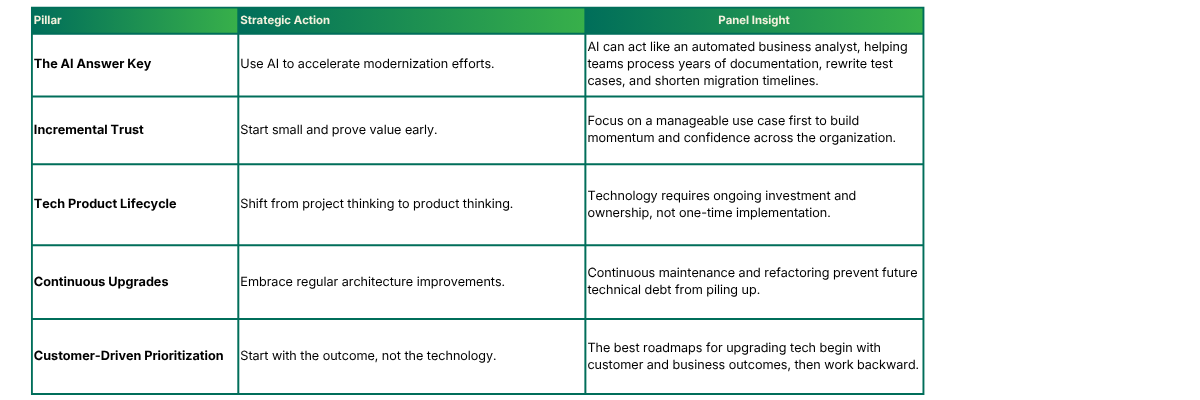
But technology is only half the battle. Josh also encouraged attendees to rethink where updating efforts actually begin. Organizations often start with the technology and work backward, but the more effective approach is to understand what internal teams, agents, and policyholders are actually trying to achieve and then build around those outcomes.
Technology should support the experience, not define it.
While there is a common consensus that legacy technology isn’t going away, neither is the pressure to modernize. Spending the most money or chasing every overhyped tech trend doesn’t automatically help an organization pull ahead; it’s having a clear vision, aligned leadership, and ultimately holding true to the discipline to continuously improve the systems that power their business.
As Josh put it, if it isn’t measured, it isn’t managed.
Just like Rome wasn’t built in a day, the future isn’t going to happen in one massive transformation project, either. If you just take it one smart upgrade at a time, you’ll actually give yourself the breathing room to effectively access your data, back your talent, and deliver the kind of experience people expect today.
Imagine if you commit to making those small, intentional changes right now, where could your business be by Insurtech Insights USA next year?
—
Written by Evy Strom for ePayPolicy. And yes, Evy actually attended the event 🙂