

Why Delegation of Authority Is the Missing Link in Enterprise Governance and Risk Management
Global enterprises are discovering that outdated Delegation of Authority frameworks slow decisions, increase compliance risk, and weaken financial control. Modern platforms are turning this administrative burden into a strategic advantage.
The 2 AM Audit Problem
Every Fortune 1000 finance executive has lived this moment.
A controller sends a message in the middle of the night: “We cannot confirm who had the authority to approve that multimillion-dollar commitment.”
The information exists somewhere in spreadsheets, emails, or buried policy documents. But it is fragmented, outdated, and not defensible.
That single gap between policy and proof is where many organizations lose control of risk, time, and trust. It is also where the next generation of governance transformation is beginning.
From Policy to Infrastructure
Most companies treat Delegation of Authority, or DoA, as a static document. It defines who can sign what and at what threshold. Once published, it often disappears into a shared drive until the next audit.
This approach no longer works. As organizations expand across markets, acquire new entities, and operate in real time, authority frameworks must evolve just as quickly. Manual tracking and spreadsheet-based systems cannot keep pace with the complexity of global decision making.
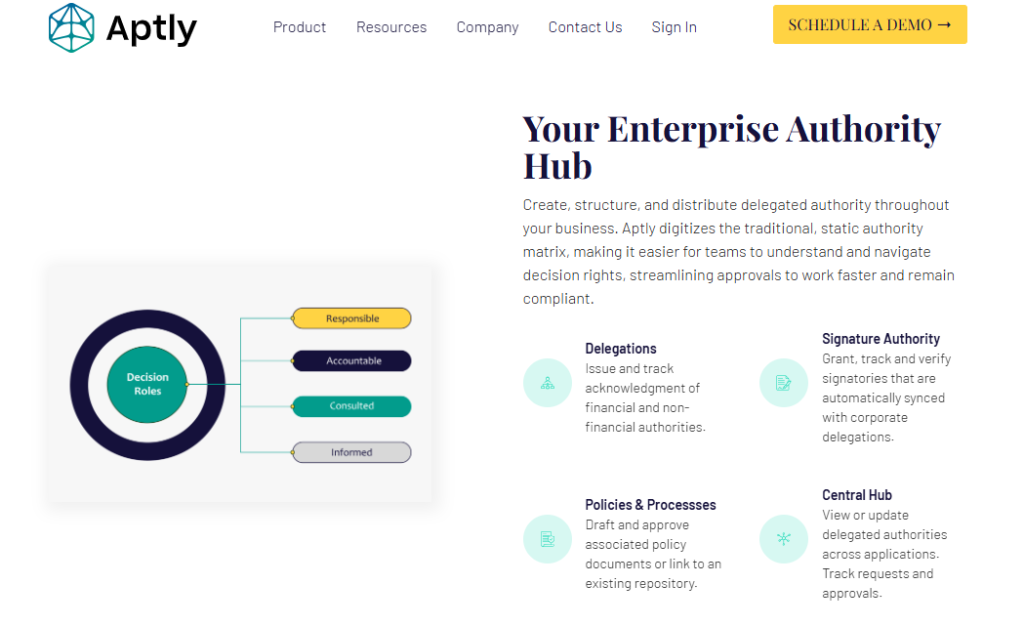
The reality is that DoA has become infrastructure. Like ERP or CRM systems, it requires architecture, integration, and continuous visibility. When modernized, it becomes the foundation of effective enterprise governance.
The Cost of Spreadsheet Governance
A global enterprise recently uncovered that a single unauthorized approval exceeded its annual technology budget. The problem was not intentional wrongdoing. It was the absence of structure.
Their authority matrix lived in disconnected spreadsheets and emails. Finance teams maintained limits in one file, HR managed roles in another, and Legal handled exceptions manually. No one could see the complete picture.
This scenario repeats in almost every large organization. The tools built for tracking static data were never meant to manage dynamic decision rights that change daily. The result is delay, uncertainty, and risk exposure that grows with every organizational change.
Why Modernization Matters
Digitizing Delegation of Authority is not simply about compliance. It is about speed, precision, and confidence. Modern platforms are delivering measurable value across several key dimensions.
Efficiency and Time Savings
Centralizing authority logic into a digital platform eliminates manual upkeep and repetitive approvals. Automation saves hundreds of hours annually and allows senior leaders to focus on strategy rather than process.
Governance and Risk Reduction
Every approval and change becomes traceable. Real-time audit logs and version histories satisfy internal and external regulatory frameworks, from Sarbanes-Oxley to ISO and DCAA. The system prevents overcommitments before they happen.
Decision Velocity
Clear decision pathways accelerate action. When teams know who owns authority, projects move faster, budgets clear sooner, and bottlenecks disappear. Deloitte research shows organizations with defined decision rights outperform peers by up to forty-five percent in earnings per share.
Digital Coworker Delegation of Authority
As organizations begin adopting agentic AI systems, autonomous software agents that perform discrete business tasks, the definition of “who holds authority” is expanding. Aptlydone enables companies to extend Delegation of Authority frameworks to these digital coworkers, ensuring they operate within defined approval thresholds, role boundaries, and audit visibility. This next-generation capability allows enterprises to safely deploy AI agents for functions such as vendor approvals, policy routing, or budget processing while maintaining the same compliance integrity as human decision makers. In effect, Aptlyd treats agentic agents as accountable participants within the governance fabric of the enterprise.
Integration Is the New Control
In the modern enterprise, authority must move at the same speed as identity. When a manager is promoted, transferred, or exits, their authority limits must adjust automatically.
Integration between Delegation of Authority systems and core applications such as ERP, HRIS, and finance platforms ensures that permissions are always current. Whether an organization uses SAP, Oracle, Salesforce, or Workday, authority should update as soon as a role changes.
This shift creates true control without friction. Identity drives authority. Systems enforce consistency. Leaders regain clarity.
Global Readiness by Design
For multinational corporations, Delegation of Authority is exponentially more complex. Different entities operate under distinct currencies, limits, and regulatory regimes.
Modern governance platforms are now built with that reality in mind. They support conditional authority logic, cumulative thresholds, and region-specific configurations. They align global standards with local needs while maintaining full visibility at the enterprise level.
This design allows growing organizations to scale governance without adding layers of bureaucracy. It also ensures that compliance requirements are met seamlessly across every market.
Culture of Accountability
An effective Delegation of Authority framework does more than prevent errors. It promotes empowerment.
By defining decision rights clearly, organizations encourage accountability at every level. Teams gain confidence to act within their boundaries, while leadership retains assurance that controls remain intact.
This balance between autonomy and oversight is what distinguishes high-performing organizations from those bogged down by red tape.
From Control to Confidence
At its core, modernizing your Delegation of Authority is about building confidence. Confidence that approvals are correct. Confidence that controls are compliant. Confidence that leaders can move quickly without fear of audit gaps.
When governance systems become digital, integrated, and transparent, organizations do not just gain control, they gain momentum.
Delegation of Authority has quietly evolved from a back-office document into a central pillar of strategic operations. It is no longer a policy but an engine for trust, agility, and growth.
About the Author
Robin Roberson is a Partner at Aptlydone.com, a purpose-built Delegation of Authority platform designed for global enterprises. Aptly enables organizations to modernize governance, strengthen compliance, and accelerate decision making with speed, clarity, and confidence.