The Hartford
reported another strong quarter in Business Insurance, with written premiums up 6% and an underlying combined ratio of 89.2%. Small business stood out, delivering 8% premium growth and a combined ratio of 89.4%, driven by double digit gains in package and commercial auto.
The strategy centers on a multichannel model. The Hartford is expanding across agents, embedded partners, and direct, aiming to meet customers at different entry points while maintaining consistent underwriting and pricing. Management highlighted growth into the small end of the middle market, the ability to shift risks from admitted to E&S, and broader product bundling.
“Our small business strategy is supported by a flexible multichannel go-to-market model. Customers have multiple ways to engage, whether it’s through agents directly or via embedded capabilities such as payroll providers. All channels provide consistent service capabilities, underwriting and pricing. An important component of our strategy is the expansion of our market-leading small business ecosystem across multiple dimensions, including size, risk, product and segment.”
The company is increasingly targeting the small end of the middle market and growing with customers as they scale, leveraging underwriting depth and product breadth. By risk profile, it can move business from admitted to E&S as exposures become more complex.
“We’ve had a technology orientation going back decades. We’ve had a partnership with agents and brokers, but primarily agents that really care about the SME space. We know what’s important to them from a service side.” – Christopher Swift.
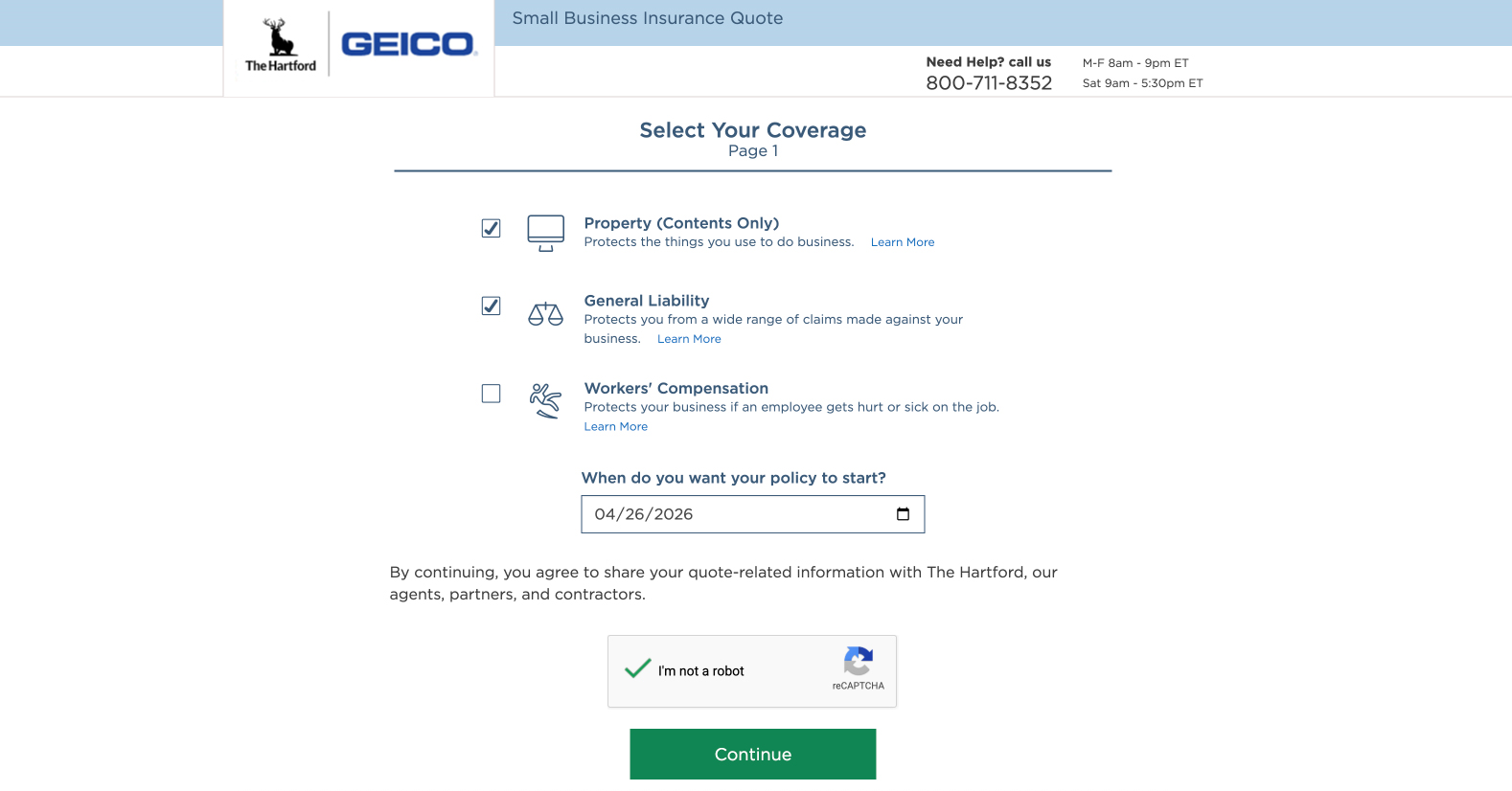
The Hartford also maintains a partnership with GEICO dating back to 2024, which now is slightly more visible in small commercial quoting flows, where
GEICO
acts as a lead source.
“And we’re one of the digital leaders in small business and increasingly in middle, particularly the small end of middle. So we’re going to continue investing in those capabilities, I think, to differentiate ourselves and make us an easier company to do business with and know our customers. So when you put it all together, I do believe that there is a moat that we got to constantly defend because there is a lot of good competition out there and a lot of good brands that agents and people recognize. But we are in a good position. We will continue to defend and invest to differentiate ourselves over a longer period of time. What happens with AI and agents and distribution in general, I think, is still a play that’s going to evolve over time. But we have deep partnerships with all our distribution partners. We have capabilities that if markets move on a direct or a more embedded basis, as I said, we’ll be ready. But we have partners that we do a lot of good servicing for and taking care of sort of our joint customers in a true partnership mindset. So we feel good about that.”
Management pointed to an uncertain impact from AI on distribution, reinforcing a flexible approach across agents, direct, and embedded channels, with different strategies by product line. “I’m not sure what AI is going to do in the agent world. And that’s why we’ve been talking more about sort of our multimodal capabilities, whether it be through agents and advice channels, whether it be direct, whether it be embedded, whether it be other technologies. And not every product line is created equal, right?”