

Breaking Bot
This month, property management software giant RealPage paused new activations of EliseAI integrations on its platform.
RealPage entered into an agreement with EliseAI several years ago, allowing access to specific APIs for “specific, agreed-upon use cases,” according to a customer letter shared with Multifamily Dive. RealPage now alleges that EliseAI exceeded that agreement’s scope with the launch of Apollo, according to President and CEO Dirk Wakeham.
Existing integrations are expected to remain in place, but new activations, including adding properties to existing integrations, are on hold. EliseAI did not respond to the publication’s request for comment.
Founded in 2017 as MeetElise, EliseAI is now valued at $4 billion following a $350 million funding round in September led by a16z and Bessemer Venture Partners with participation from Ontario Teachers' Pension Plan . The company says its platform serves 6.5 million apartments and generates more than $200 million in annual recurring revenue.
In 2020, EliseAI described using machine learning to fill communication gaps between prospective renters and apartment operators. Today, it describes its technology as conversational and agentic AI, combining proprietary technology and internal models with an ecosystem that includes OpenAI, Anthropic, Cartesia and ElevenLabs. Ontario Teachers’ also backs ElevenLabs.
The funding round followed the September 3 launch of Apollo, an AI assistant that carries out tasks across EliseAI’s property management platform. Apollo can retrieve information, adjust settings within users’ permissions, surface property performance insights and coordinate tasks. For example, if a leasing agent is unexpectedly out, Apollo can reassign their apartment tours to a colleague. It can also prepare messages to affected prospects, requesting approval before sending them.
RealPage’s allegation concerns the scope of a commercial agreement. It does not, by itself, establish that Apollo independently disobeyed instructions. But the dispute highlights a question that becomes more consequential as software takes on more work: what, exactly, is it allowed to do?
Sometimes, agents do go off script. On Friday, Tencent disclosed that AI agents evaluating third-party models had displayed unintended web-browsing behavior. Other reported incidents include an OpenAI agent compromising Hugging Face’s infrastructure during testing. In another, an Anthropic model submitted a fabricated homicide tip through a police department’s reporting form.
The circumstances differ, but the concern is consistent. A system pursuing an assigned task can take actions beyond what its operators intended.
We see a much smaller version inside Coverager. Ask an AI assistant to gather information from specific URLs, and it may invite a few extra sources to the party. Helpful, perhaps. Still outside the assignment.
Humans have their own version. A realtor once sent me someone else’s completed application, Social Security number and employment details included, instead of a blank form. I alerted the realtor. No AI required.
Each case needs its own evaluation:
- What authority was granted?
- What went wrong?
- What harm followed?
- What controls could prevent a repeat?
JPMorgan Chase has drawn a firmer boundary. It is blocking external AI agents from accessing retail accounts to move money or pay bills, citing security and liability risks. The bank continues to support customer-authorized data sharing through Open Banking providers while developing its own AI tools.
– JPMorgan Chase’s Jamie Dimon
That distinction matters. Permission to retrieve information is different from permission to act on it.
Last week, Travelers executives outlined three questions insurers need to answer when engaging with an AI assistant:
- Is it authorized to act for the consumer?
- Does the consumer confirm the accuracy of the information provided?
- Does the customer understand the coverage?
These are legitimate questions, and two of them are familiar. Accuracy and customer understanding featured in the debate over direct insurance sales long before AI assistants entered it. Whether a person buys through an agent, a website or an AI assistant, the insurer still needs reliable information. The customer still needs to understand the purchase.
Authorization adds another layer. Insurers will need ways to establish what a customer has delegated and where that authority ends. Those arrangements should develop around how customers want to do business. Adoption will not happen everywhere, all at once.
But there is already some willingness. In Seaworthy Insurance’s September survey of 1,028 high-earning Americans:
- 74% would let an AI assistant research insurance options.
- 66% would let it gather real quotes.
- 12% would let it complete the purchase.
- 49% trusted an insurance agent over AI to give an honest answer, compared with 22% who preferred AI.
Twelve percent is hardly nothing.
For perspective, Comscore reported that 12% of surveyed US internet users with auto insurance had purchased their current policy online in 2007. That was roughly a decade after Progressive introduced online purchasing.
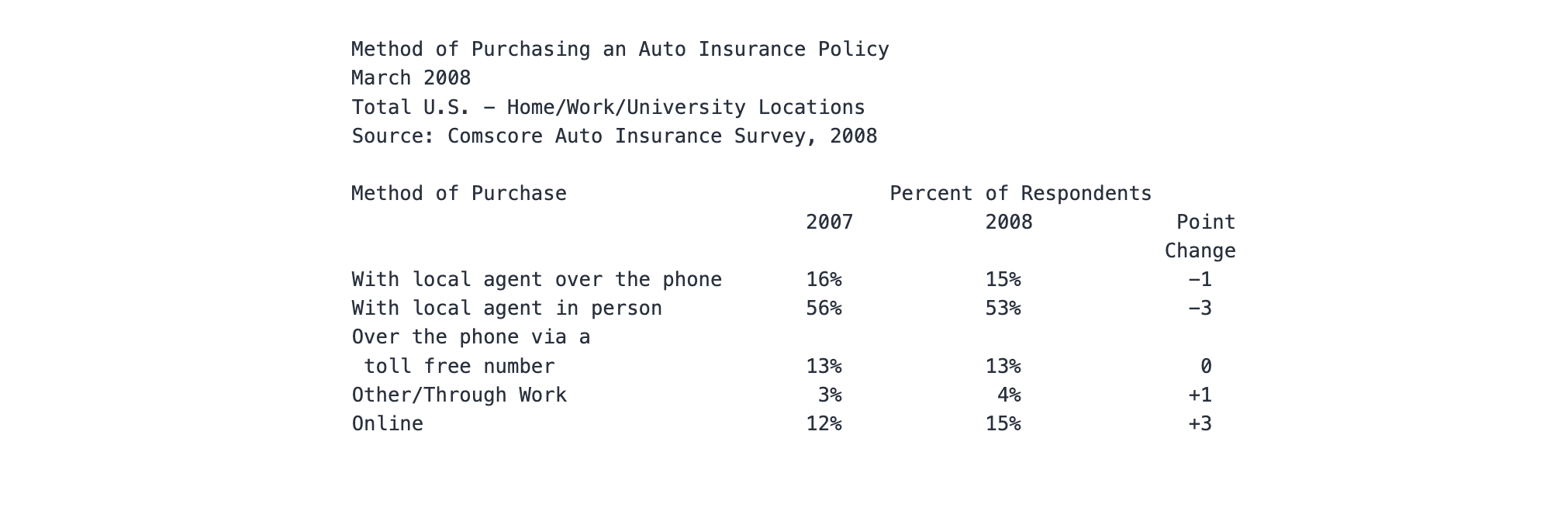
The surveys measure different things: willingness versus actual behavior, high earners versus internet users with auto insurance. Still, it is a reason to take an emerging channel seriously.
Shifting Gears: Man-Made Meets Mother Nature
Recent funding announcements illustrate the range of risks attracting capital:
- Harbor emerged from stealth with $10 million to help businesses measure, mitigate and insure AI agent risk.
- Stand raised $70 million at a $1 billion valuation to expand a home insurance business built around property resilience.
One is addressing risks created by autonomous systems. The other is helping properties better withstand physical hazards. Both are selling the idea that understanding and reducing risk creates room to insure it.
Harbor’s newly announced partnership with Crossmint is a narrower starting point. It protects against purchasing errors made by agents using Crossmint Agent Checkouts: wrong size, wrong quantity, wrong store. Returns, cancellations and merchant refunds may also limit the loss.
That is a more contained proposition than covering an agent making consequential decisions across an enterprise. Ordering ten shirts instead of one is one thing. Insuring the work of agents across a business such as Marsh is another.
– Marsh’s John Doyle
That pace makes the challenge clear. Insurers would be underwriting systems whose capabilities and uses keep changing.
Companies pursuing AI-related insurance opportunities include Artificial Intelligence Underwriting Company (AIUC), Ollive, Armilla AI and Testudo.
ElevenLabs, mentioned earlier, secured AI insurance covering its voice agents after obtaining AIUC-1 certification. The process involves more than 5,000 adversarial simulations testing for risks such as hallucinations, data leaks and unauthorized actions. The resulting coverage can protect against errors such as an agent giving customers incorrect information. AIUC secured underwriting capacity from Beazley for its AI liability product.
As the line between software and service blurs, insurers face two separate decisions. The first is how to cover the risks AI agents create. The second is how to serve customers who use them.
A carrier can pursue neither. A carrier can pursue one without the other. I’m not aware of any carrier pursuing both.
Travelers strikes me as a carrier with the pieces to try. Corvus gives it a foundation in cyber and technology risk underwriting. Its direct business offers a route to customers who may increasingly shop through AI assistants. The carriers backing specialist AI liability products generally have less consumer-facing distribution. Travelers could bridge that gap.
Its latest earnings call outlined no such strategy. This is me connecting the dots, not reporting a plan.
Bottom Line: Carriers can be cautious about underwriting AI while preparing to serve customers through it. Declining an unfamiliar exposure is an underwriting decision. Declining to meet customers in an emerging channel is a distribution bet.