
Reserv CEO: Carriers don’t need SaaS wrappers around LLMs
Reserv CEO CJ Przybyl sits down with Coverager to discuss AiDE , the company’s early relationship with Accelerant, the rise of new claims competitors, and why carriers don’t need SaaS wrappers around LLMs.
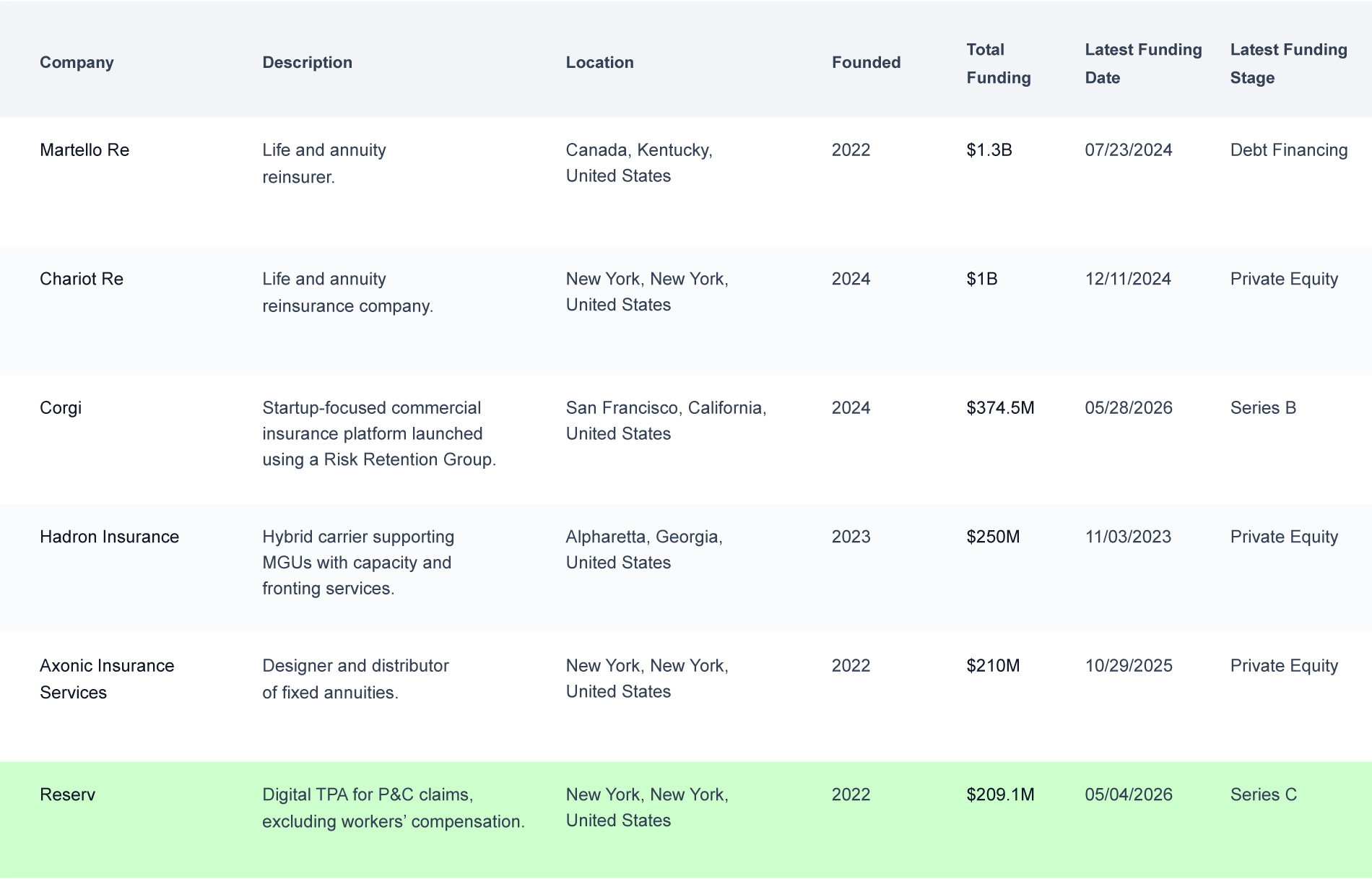
01. Reserv ranks sixth by total funding among US insurance companies founded since 2022, with roughly $209 million raised. Just as notable is its backing from industry players including Arch, AXIS, QBE, and Convex—an advantage few startups can replicate. Given that position, why separate the technology through AiDE instead of keeping it exclusively within Reserv?
The TPA division of Reserv, Inc. – Reserv Claims Analysis, LLC – will still be the sole TPA granted access to this technology. However, one of the main objectives when starting Reserv was to build the “clean room” to test claim technology quickly and share the learnings with the larger carriers that adjust claims in-house. The onset of generative AI has accelerated the delivery of this mission, so we are just making good on our promise to provide our technology and insights to the broader industry that services claims in-house. All of the industry players stand to gain from, for example, the shift from success fees to token cost plus pricing models. We know this is going to generate some ripples across the market and we welcome this.
02. Reserv was one of the earliest digital-native TPAs to launch, followed by companies such as Elysian and ClaimSorted in 2024. My understanding is that Accelerant helped connect Reserv with some of its earliest MGA clients. How did that relationship come about, and how important was it to Reserv’s early growth?
Accelerant, Bain Capital, Altai Ventures, and Runyon actually incubated Reserv even prior to my joining as the CEO and co-founder. This is an example of the industry identifying its own pain points with existing vendors and finding an elegant and unique solution. Through a bit of luck and fate, we all connected when we did. Combining my expertise in claims services and technology, with Accelerant’s steady flow of technology-forward clients and real-world insights, we powered Reserv’s initial debut on the market. It has clearly taken on a life of its own since then, and the original incubating team has been gracious in giving me the flexibility and autonomy to build and optimize the company to service the entire market of needs.
03. You’re part of a growing club of founders on their second insurtech act. You started with Snapsheet; Dan Preston went from leading Metromile to tackling high-risk property insurance with Stand; and Corvus co-founder Mike Lloyd launched AACI Group and Pine View Insurance Group after Corvus’s $435 million sale to Travelers. With so many repeat founders still trying to change insurance, what is the one constant you’ve found remains unchanged and uniquely insurance?
The one constant I’ve found in the industry is that insurance will remain unchanged. No startup is doing anything that will vastly disrupt insurance anytime soon. Insurance is a commodity product that is regulated and required by the government. I think that the repeat founders have all learned to raise money responsibly, spend efficiently, and solve the problems in the industry versus trying to change the industry.
04. We’ve mentioned Corgi, which—true to its brand—has been barking up a lot of trees: running a café, launching a document-management platform, dabbling in asset management, and reportedly eyeing trucking. Now it has launched Corgi Claims, a full-service TPA. Do you consider Corgi a serious competitor, and what will ultimately separate the winners from the rest?
The private equity companies have proven time and again, specifically in insurance, that you can consolidate existing vendors, add operational value, and exit at a great multiple. We have also seen many recent spin-out strategies, such as Inshur with Komodo, Nirvana with Vega Claims, and even CSAA and Mobilitas IQ. This is not a winner-takes-all market. When VC dollars are flowing and new minds are spinning, the only thing we can bet on is that great talent will flow into the industry, and every current operating assumption will be challenged. I’d like to think I helped launch the first wave of claims innovation with Snapsheet, and now at Reserv, and I welcome the next wave pushing us all out of our comfort zones to advance the industry.
05. AiDE’s opening line speaks to the power of data: “The technology that ingests, structures, migrates, and analyses insurance data, with modular solutions built and tested on real portfolios.” Bring that to life for our readers: What does actionable data actually look like for a client, and what can they do with it that they couldn’t do before?
Actionable data fundamentally means that all of the structured and unstructured data can be token-efficiently accessed for the task at hand. On the data analysis and real-time triage side, it’s not always bringing carriers functionality they didn’t have before; it’s just doing it way more cost-effectively and accurately while also better integrating it into their existing workflows. Pro-active monitoring for subrogation, bill reviews, document detection, always-on claim triage, even full FNOL automation – these are all features various carriers have built or purchased, but can now be done cheaper and with a much higher level of accuracy to achieve the right outcomes.
Carriers don’t need SaaS wrappers around LLM-based products; they can now build it better themselves. This leads into the more exciting benefit: long-term value creation owned by the carriers. When all data is fully extracted, structured, and accessible in an “LLM-ready” system, carriers have perfect information on every claim file and how it relates across their entire system and portfolio. They can now use the new LLM back-end coding and front-end design tools – along with the dearth of consulting talent looking for their capex spend – to build the specific orchestration workflows they want. That is what I think will be the biggest unlock (and has been for us at Reserv). Ultimately, we want to provide the infrastructure so carriers can focus on results and future-proof themselves against technological disruption.