

Your PAS Has APIs. They’re Not AI-Ready.
Why having APIs and being AI-ready are two very different things — and what the gap actually looks like.
Every major policy administration vendor will tell you they have APIs. They’re right. Your 20-year-old in-house system probably has them too.
So when the conversation turns to AI, the assumption feels reasonable: we have APIs, AI tools consume APIs, therefore we’re ready. That assumption deserves more scrutiny than it’s getting.
The gap between having APIs and having AI-ready APIs is where most insurance AI initiatives quietly stall. The result is what we’ve started calling the industry’s most expensive illusion: pretty frontends with no insurance inside.
Two Kitchens
Imagine putting a robot chef into two different kitchens.
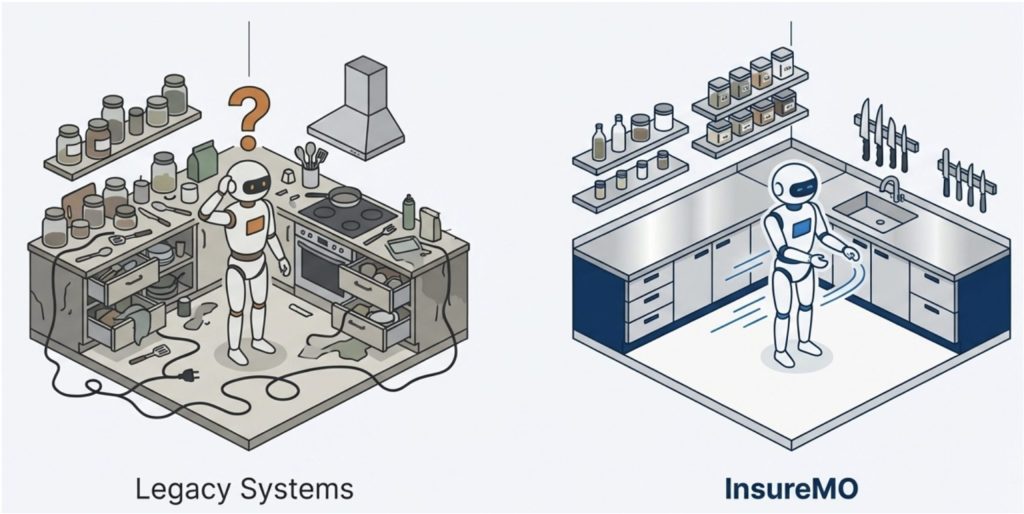
In the first, ingredients aren’t labeled. Knives are tangled with electrical cords. Spices are scattered across three rooms. The stove runs on proprietary fuel and requires a specialist to ignite. The robot has extraordinary capabilities, but it can’t find anything, can’t read anything, and can’t safely operate the equipment.
In the second kitchen, everything is organized. Ingredients are clearly marked. Tools are accessible. Equipment runs on standard power. The robot starts cooking immediately.
Same robot. Same ingredients. Radically different outcomes. The difference isn’t the robot’s intelligence. It’s whether the kitchen was organized for machine use.
Most insurance API environments look like the first kitchen.
What Goes Wrong
When an AI coding tool — Claude, Cursor, GitHub Copilot, or any of the increasingly capable code generation agents — tries to work with a typical PAS API layer, the failures are predictable.
Start with language. Many core platforms use proprietary domain-specific languages or custom configuration formats. AI models are trained on billions of lines of Python, JavaScript, Java, and standard REST patterns. They’re not trained on languages that exist in a single vendor’s ecosystem. When asked to write against these APIs, AI doesn’t refuse. It hallucinates. It produces code that looks syntactically plausible but fails at runtime.
Then there’s granularity. Traditional insurance APIs were designed for human developers who understood the full context of what they were building. A single endpoint might bundle dozens of operations — policy creation, validation, rating, and binding — into one call with complex parameter combinations. A human developer reads the documentation, understands the implicit sequence, and writes the integration over weeks. An AI agent needs atomic, single-purpose operations it can discover, understand, and compose on its own. It can’t decompose what it can’t see.
Finally, there’s institutional knowledge. Legacy APIs are full of undocumented assumptions — fields that mean different things in different contexts, sequences that must be followed but aren’t enforced, workarounds that everyone on the team knows but nobody has written down. AI has none of that tribal knowledge. And unlike a new hire, it can’t walk down the hall and ask.
The cumulative effect: AI generates applications that look correct, pass basic validation, and completely fail to transact actual insurance. Beautiful interfaces with no insurance logic underneath. It’s the most expensive kind of technical failure because it looks like progress right up until you try to bind a policy.
What AI-Ready Actually Looks Like
To see the difference, walk through a simple scenario: an AI agent building an embedded quote-to-bind flow for a bancassurance partner.
Against a legacy API layer, the agent hits walls immediately. It finds a processPolicy endpoint that handles quoting, validation, and binding in a single call, but the required parameter combinations aren’t documented in any machine-readable format. The agent guesses. Some guesses work. Most don’t. Three days later, a human developer is debugging the AI’s output line by line, which is roughly what would have happened without AI in the first place.
Against an AI-ready API layer, the scenario plays out differently. The agent discovers a set of atomic, single-purpose operations — getProductConfig, calculatePremium, validateEligibility, createQuote, bindPolicy — each with self-describing parameters in standard OpenAPI format. It reads the specs, understands the sequencing, composes the flow, and generates a working application. Not a prototype. Not a demo. A working application that can actually transact insurance, deployed in an afternoon.
The characteristics that make this possible aren’t mysterious, but they require deliberate architectural choices that legacy platforms never had reason to make. Atomicity — fine-grained, single-purpose endpoints rather than monolithic multi-operation calls. Standard languages — REST, JSON, OpenAPI specs that AI models have encountered billions of times in training, rather than proprietary DSLs that exist nowhere else. Semantic clarity, where endpoint names, parameters, and responses make their purpose obvious without external documentation; an agent shouldn’t need to decode what processTransaction(type=7, flag=true) means.
Beyond individual API design, AI readiness demands domain completeness and machine discoverability. Coverage must span the full spectrum of insurance operations — product configuration, policy lifecycle, claims, billing, reinsurance, distribution — because gaps force AI to invent workarounds, and AI-invented workarounds in insurance are a compliance risk, not a feature. And the entire API surface must be explorable by machines: not documentation buried in PDFs or wikis, but structured specifications that let an agent autonomously map available operations and their relationships. Ask yourself whether an AI agent could discover everything your APIs offer without a human walking it through. If the answer is no, the kitchen isn’t ready for the robot.
The Wrapper Objection
At this point, the obvious response is: “Can’t we just build a translation layer on top of our existing APIs?”
You can try. Many will. But a wrapper inherits the structural limitations of what it wraps. If your underlying API bundles fifteen operations into a single endpoint, your wrapper team has to decompose that into atomic calls — which means encoding all the implicit business logic, sequencing rules, and exception handling that the original API assumed a human developer would know. You haven’t simplified the problem. You’ve moved it.
The more sustainable approach is an API layer designed from the ground up for machine consumption — one that sits between your core systems and the AI tools your teams want to use, providing the atomicity, discoverability, and semantic clarity that AI requires. This isn’t about replacing your PAS. It’s about making it accessible to the development paradigm that’s already transforming every adjacent industry. This is the architectural pattern InsureMO was built around — an API layer of 10,000+ atomic insurance operations in standard REST and OpenAPI formats, designed for exactly the kind of machine consumption that AI coding tools require.
The Divergence
The insurers who close this gap will experience something that sounds like exaggeration until you see it: product launches that once took months happening in weeks. Partner integrations that required dedicated teams now requiring a prompt and a weekend. New channels, new customer experiences, new distribution models — deployed at a pace that legacy integration timelines cannot match.
The insurers who assume their existing APIs are sufficient will spend the next several years puzzled by why their AI investments aren’t producing results. The models will keep getting better. The prompts will keep getting more sophisticated. And the outputs will keep failing at the point where they need to actually transact insurance, because the kitchen was never organized for the robot.
The API-readiness gap is real, it’s architectural, and it’s widening. The question is no longer whether AI will transform insurance distribution and operations. It’s whether your infrastructure is ready to let it.
About InsureMO
InsureMO is the global insurance infrastructure platform. The platform is organised across three pillars, API, Data, and AI, with thousands of atomic, domain-specific APIs spanning the full insurance lifecycle from quotation to claims. The architecture is open by design: the same APIs that connect 8,700+ distribution channels and technology partners are equally discoverable by AI agents and coding assistants. This is what makes InsureMO both ecosystem-friendly and AI-friendly; any AI tool that can call an API can build on InsureMO.
Over 500 insurers, distributors, and ecosystem partners across 50+ countries run on InsureMO, processing more than US$25 billion in Gross Written Premium across 17,500+ configured products spanning Life and Health, Personal Lines, Commercial and Specialty, and Reinsurance.
Create & Connect