

Why 85% of Adjusters Adopted This AI Tool (When Most AI Rollouts Fail)
The insurance industry is facing a compounding crisis. One carrier found a way out—by breaking nearly every rule of enterprise AI deployment.
Here’s a number that should stop every claims leader in their tracks: 70-80% of AI projects fail to deliver expected benefits—not because the technology doesn’t work, but because employees won’t use it.
So when a publicly-traded P&C carrier operating in one of America’s most litigious states achieved 85%+ adjuster adoption of an AI correspondence tool, the natural question isn’t “what did they buy?” It’s “what did they do differently?”
The answer challenges nearly everything the industry assumes about technology rollouts, training, and talent.
It’s a topic I discussed with the Director of Claims at Heritage Insurance last quarter, and I wanted to share more details with fellow Coverager readers.
The Compounding Retirement Crisis
The insurance industry is caught in a doom loop that gets worse with every resignation letter.
According to CUNY School of Public Health research, burnout costs employers between $4,000 and $21,000 per employee annually in lost productivity and turnover. For a carrier with 1,000 employees, that’s up to $5 million per year. Given the specialized skills and ramp-up time for claims adjusters, those numbers likely understate the real impact.
But here’s where it gets worse: the World Economic Forum’s 2025 Future of Jobs Report ranks claims adjusters among the top 15 professions facing the steepest decline by 2030. The U.S. Bureau of Labor Statistics projects 21,600 annual openings for adjusters over the next decade, all from replacement needs as workers transfer out or retire. The pipeline isn’t just shrinking; it’s being abandoned.
The carrier in this case study was living this reality:
- 90+ days of close supervision required for even industry-experienced hires
- Months to fill open positions
- 2 to 4+ hours daily lost to policy lookups and letter formatting
- Mounting regulatory fines from missed correspondence deadlines
Every burned-out adjuster who quit made the remaining team’s workload heavier, accelerating the next departure. Every inexperienced hire required supervision time from the experienced adjusters who were already drowning. The math was unforgiving.
Why Most AI Rollouts Fail
Before examining what worked, it’s worth understanding why most enterprise AI deployments don’t.
A recent EY survey found that 75% of employees worry AI could eliminate jobs, with 65% fearing specifically for their own roles. Meanwhile, only 34% of managers feel equipped to support AI adoption. The Cloud Security Alliance reports that up to 70% of change initiatives fail due to employee pushback or inadequate management support.
The psychology here is well-documented. Employees don’t trust what they don’t understand. When AI systems feel mysterious or unpredictable, people instinctively assume the worst. And here’s what makes AI adoption uniquely difficult: employees place disproportionate weight on AI errors. When a machine makes a mistake, it feels more alarming than when a colleague slips up, even if humans make far more errors. Psychologists call this “algorithm aversion.“
The typical enterprise response? Mandates, training sessions, and change management programs that treat adoption as a compliance problem. MIT Technology Review research found that fewer than half of leaders (39%) rate their organization’s psychological safety as “very high.” In other words, most companies are attempting AI adoption on cultural foundations that aren’t stable.
The carrier in this case study took the opposite approach.
The Counterintuitive Approach
Instead of mandating adoption and building training around the technology, the carrier did two things that shouldn’t have worked together, but did.
First, they transformed training itself.
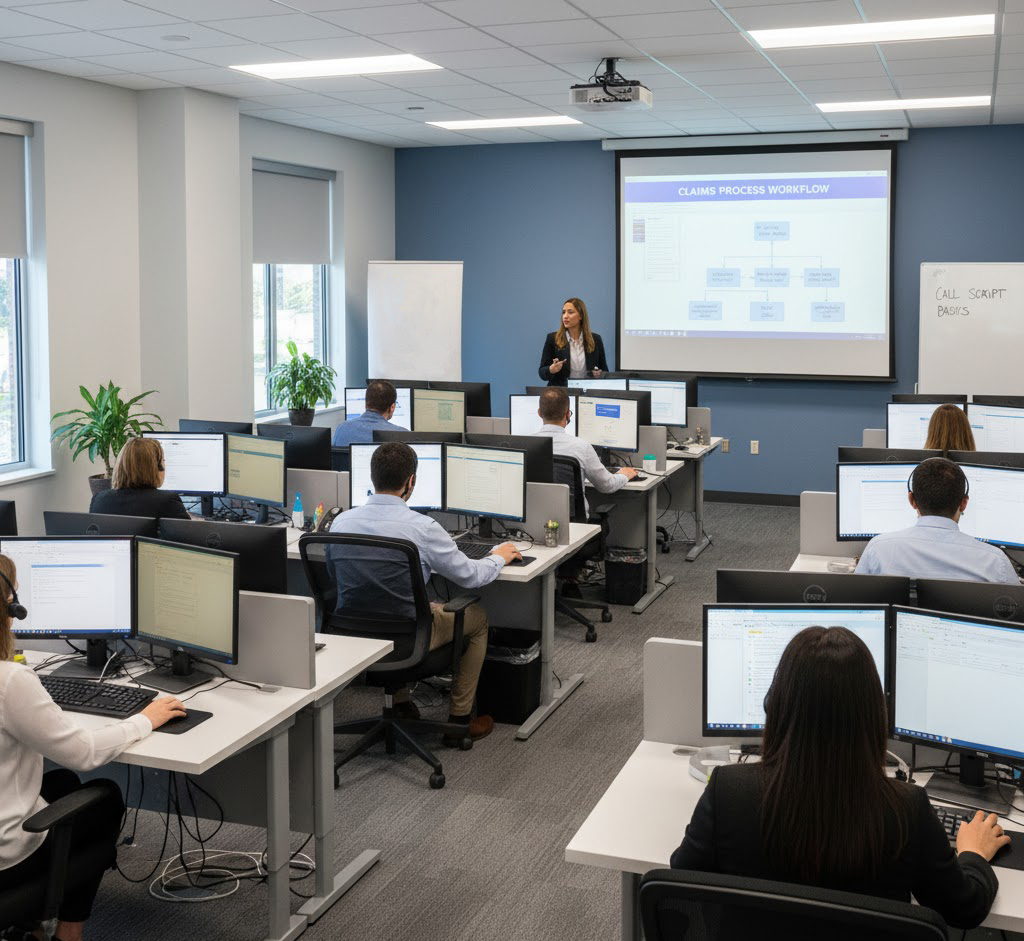
Traditional claims training is theoretical: classroom sessions, policy manuals, certification exams. The carrier introduced simulation-based training where new hires worked through dozens of complete claim lifecycles, including AI-assisted correspondence, before touching live work.
The program was deep enough to change their hiring criteria. Prior adjusting experience became optional. The carrier could now evaluate candidates on aptitude and train for skill.
The result? Over 12 months, 50% of new hires came with zero prior adjusting experience. Managers gained visibility into trainee capabilities through simulated work product. New hires arrived floor-ready, projecting confidence from their first customer interaction.
Research supports this approach: a Brandon Hall Group study found that strong onboarding programs improve new hire productivity by over 70%. Another study of a health insurance call center found that switching to blended, simulation-based onboarding shortened time-to-proficiency from nine months to six weeks.
Second, they treated the AI vendor as a partner, not a supplier.
Rather than mandating Voltaire adoption, the carrier created direct feedback loops. Adjuster input flowed to training leaders, who conveyed it directly to Voltaire’s team. Changes were implemented in days, not months.
When skeptical adjusters saw their feedback actually change the product, something shifted. Early adopters’ time savings became visible to their peers. The 2 to 4+ hours of daily productivity gains weren’t a pitch, they were an observable fact. Organic adoption replaced mandated compliance.
This tracks with what MIT Technology Review found in their AI adoption research: 83% of executives surveyed believe a company culture that prioritizes psychological safety measurably improves the success of AI initiatives. The carrier built that safety not through programs, but through demonstrated responsiveness.
What the Research Says About Why This Worked
The results speak for themselves:
|
Metric |
Result |
|
AI tool adoption |
85%+ |
|
Daily time savings per adjuster |
2 to 4+ hours |
|
Adjuster satisfaction increase |
42% (6.5 to 9.25 out of 10) |
|
New hires without prior experience- |
50% over 12 months |
That 42% satisfaction jump deserves particular attention. Oxford University’s Saïd Business School established a clear causal link between happiness and productivity, finding that happy workers are 13% more productive. Gallup research found that disengaged employees cost businesses nearly $2 trillion annually in lost productivity.
When adjusters rated their satisfaction at a 6.5 average before the transformation and 9.25 average after, they weren’t just saying they felt better. They were signaling that a core friction in their daily work had been addressed.
The carrier didn’t just deploy AI. They identified the specific daily pain, hours lost to policy lookups, letter formatting, or template searching, and eliminated it. By doing so, they expanded who could do the job effectively.
The Implications for Claims Leaders
Three patterns from this case study challenge conventional thinking:
1. Training and technology aren’t separate initiatives—they’re one system.
The carrier’s simulation-based training included Voltaire from day one. New hires learned to leverage AI before they had ingrained manual habits to unlearn. Tenured employees, seeing the program’s success, requested enrollment for skill enhancement. The distinction between “technology rollout” and “training program” dissolved.
2. Adoption follows demonstrated value, not mandates.
Prosci research on enterprise AI adoption found that 38% of adoption challenges stem from insufficient training, but the deeper issue is trust. Employees adopt tools they believe will help them. The carrier built that belief not through messaging, but through rapid iteration: feedback given, changes made, results visible.
3. Expanding the talent pool may matter more than optimizing the existing one.
The carrier’s most radical outcome wasn’t the time savings, it was that 50% of new hires had no prior adjusting experience. In an industry facing structural talent decline, the ability to hire for aptitude rather than experience changes the fundamental math.
Download the Case Study or request a customized business case for your carrier.
Voltaire generates accurate, compliant claims correspondence that automatically cites accurate policy language.